
Evidence note: The revenue figures below come from interviews in which Justin Welsh described his own business. They are founder-reported, not audited financial statements. Sales, revenue, profit margin, ARR and personal wealth are different measures; this article keeps them separate.
In 2019, Justin Welsh did not leave a senior startup role to launch a polished online course empire. He began by writing about his work on LinkedIn while preparing to become an independent consultant. Seven months later, he says he had built an audience of about 20,000 people. When he launched his consulting practice on August 1, 2019, he reported closing about $40,000 in client business on the first day. The audience had become a sales pipeline before he had a course to sell.
Five years later, in a 2024 interview with Starter Story, Welsh said his business had reached about $3.85 million in annual revenue, helped by a flagship course launch that generated roughly $1.51 million in less than a week. Those are substantial numbers, but they are his own disclosures, not independently audited accounts. The more useful lesson is the sequence behind them: publish useful expertise where prospective customers already spend time, notice what they ask for, package a repeatable answer, and move the relationship from a social platform into an email list and paid product.
Who Is Justin Welsh?
Welsh is an American writer and creator-business operator. His current About page says he lives in the Catskill Mountains of New York with his wife and runs a one-person business teaching creators how to identify, develop and monetize skills online. Starter Story listed him as based in Accord, New York, in its 2023 profile.
Before going independent, he was a senior sales executive at PatientPop, a healthcare technology company. In his 2023 interview, he said he had helped the company grow from zero revenue to more than $50 million in annual recurring revenue over roughly four and a half years. His current biography also says he helped build two companies past $1 billion valuations and raise more than $300 million in venture capital. These are claims about companies he worked for, not funding or valuation for his own creator business.
In 2018, he experienced severe burnout and decided to step down from his executive role. He stayed on until August 2019, giving himself several months to prepare. The important point is that he did not start with a blank résumé: he already had sales experience, a professional network, and practical knowledge of how a growing software company acquires customers.
The Product: Turn Experience Into a Repeatable System
Welsh’s business sells practical knowledge to people who want to build an audience and turn their expertise into an online business. Its core products have included The LinkedIn Operating System, The Content Operating System and The Creator MBA. The courses are self-paced digital products rather than high-touch coaching programmes that require a sales team or recurring live calls.
The product promise is specific. One course teaches a repeatable process for building a LinkedIn presence and converting attention into business opportunities. Another teaches how to produce a newsletter and a steady stream of social content. The Creator MBA expands the offer into a broader playbook for building a modern online business.
The business also has supporting revenue streams: newsletter sponsorships, a paid templates product, affiliate income, and occasional advising, coaching or speaking. The free Saturday Solopreneur newsletter is both a useful product in its own right and a distribution channel for the paid offers.
Development Timeline: From Consulting to Digital Products
- December 2018: After a period of burnout, Welsh told his CEO he wanted to step down. He agreed to stay until August 2019 and began preparing an independent consulting business.
- Early 2019: He started publishing on LinkedIn about his experience building PatientPop. In his account, he grew from zero to roughly 20,000 followers in about seven months. He paid a web-design company about $20,000 for a Squarespace site. That is a disclosed website investment, not a complete startup-cost figure.
- August 1, 2019: He launched his consulting business and said he closed about $40,000 in client business on day one. Treat this as booked client work as he described it, not necessarily cash collected that day.
- 2020: People began asking him how he wrote content, grew his audience and turned followers into customers. He responded with a $50 course called The LinkedIn Playbook. He reported selling about 1,500 copies in a year, equivalent to roughly $75,000 in gross course sales before fees, refunds and costs.
- Late 2020: He increased his LinkedIn activity and began publishing on Twitter, now X. He said his combined social following passed 300,000.
- July 2021: He pre-sold The LinkedIn Operating System roughly 30 days before launch. He built a simple Carrd landing page, emailed a list of about 4,000 people and published three LinkedIn posts. He reported about $75,000 in launch-month sales.
- Late 2021: When daily course revenue passed roughly $1,500, he decided to close the consulting practice and focus on the creator business.
- 2022: He reported about $1.7 million in top-line business revenue and a roughly 95% profit margin. These were founder-reported figures, not audited results. He also described growing through LinkedIn, X, SEO, newsletter and affiliates.
- January 2024: He launched The Creator MBA. In a follow-up interview, he said the launch generated about $1.51 million in less than a week and that annual business revenue had reached about $3.85 million. He also said he had enrolled more than 30,000 students across his products and hired his first virtual assistant after five years of operating solo.
- 2026 public positioning: His current website describes the business as a “$15M Solo Business”. The page does not define the period or accounting basis behind that headline, so it should not be read as $15 million in annual revenue, profit or personal wealth.
How He Acquired Customers
The acquisition engine was not one viral post. It was a connected system built around repeatable publishing and a clear next step.
1. LinkedIn created the first audience. Welsh posted about real work he had done in SaaS sales and growth. In his 2023 interview, he said he published one original post each weekday up to 2022, then increased to twice daily, seven days a week, during the second half of that year. He reported 118.2 million LinkedIn impressions and 280,900 website visits in 2022. Those are his platform analytics, not third-party audited traffic.
2. X broadened distribution. He began publishing on Twitter in October 2021. He reported growing from about 8,000 followers to 325,000 in 16 months, with roughly 198.4 million impressions and 129,200 website visits in 2022. This was an additional channel, not a replacement for LinkedIn.
3. Email converted rented attention into an owned audience. The weekly Saturday Solopreneur newsletter gave readers one practical idea in a short format. It also gave Welsh a channel he could reach without depending entirely on a social algorithm. His current homepage says the newsletter is read by more than 200,000 people, while his About and sponsorship pages display 150,000-plus or 155,000-plus figures. Those public pages are not consistent, so the exact current subscriber count should be treated as unverified.
4. SEO added a slower, compounding source of visitors. In January 2022, he moved from a simple Carrd site to Kajabi and hired a specialist to handle technical SEO and redirects. He said free articles, guides and newsletter issues generated more than 45,000 new organic website visitors during 2022. In 2024, he said he had expanded further into organic SEO, Instagram and Threads as LinkedIn became more crowded.
5. Students became a referral channel. Welsh described an affiliate programme that paid a 35% commission. In his 2023 interview, he reported more than 1,570 affiliate conversions at an average revenue per conversion of $130.25, or more than $200,000 in top-line revenue. The lesson is that a satisfied customer can become a distributor when the product has a clear outcome and the referral economics are transparent.
Business Model, Pricing and Cost Structure
The model combines one-time digital-product sales with recurring and partner revenue. The current official course store lists The LinkedIn Operating System and The Content Operating System at $200 each. Prices can change, and this is the public list price observed on November 9, 2026. In 2023, Welsh described the flagship LinkedIn course at $150; the earlier price should not be mistaken for today’s listing.
The official sponsorship page currently lists a $3,000 placement in The Saturday Solopreneur and advertises up to two sponsor placements per issue. It also publishes its own performance claims, including a 50% average open rate, 77,000-plus sponsorship views and 500–1,000 clicks depending on relevance and copy. These are seller-provided media-kit metrics, not independently audited campaign results. The sponsorship page’s audience figure also differs from the current homepage, which is another reason not to treat marketing-page counts as audited facts.
In a 2022 Indie Hackers interview, Welsh said his recurring monthly revenue came from a paid email product called The Monthly Templates, while the rest came from course sales, sponsorships, coaching and affiliate deals. This mix matters: courses provide larger one-time payments, a subscription adds a recurring base, and sponsorships monetise the attention of the newsletter audience.
Costs include the website and course platform, email delivery, analytics, scheduling tools, payment processing, affiliate commissions, customer support and the founder’s own time. Welsh disclosed a $20,000 website build in 2019 and a 35% affiliate commission in his earlier model. He also said he had no full-time employees in his 2023 profile; in 2024 he reported hiring a first virtual assistant. The assistant’s cost, current operating expenses, taxes and payment fees are not disclosed.

Startup Cost, Current Scale and Earnings: What Is Actually Known?
Startup cost: A complete itemised launch budget has not been disclosed. Welsh said he had saved roughly 90 days of runway before leaving his job, and he disclosed spending about $20,000 on a website before launching consulting. That is one known expense, not the total cost of starting the business. Software costs, legal/accounting fees, equipment, living costs and the opportunity cost of his labour are not fully documented.
Revenue: He reported about $1.7 million in top-line revenue for 2022 and about $3.85 million in annual revenue in the 2024 follow-up interview. He also reported a roughly $1.51 million launch for The Creator MBA in less than a week. These are gross business revenue claims from the founder, not audited financial statements. The 2026 “$15M Solo Business” headline on his website does not specify whether it means cumulative revenue, a valuation, or another measure; it is not evidence of $15 million in annual sales.
Profit: Welsh described a roughly 95% profit margin for 2022. The calculation method and expense definition were not published, so it should be treated as a founder-reported margin, not a verified net margin. Current profit is not disclosed.
Personal wealth and funding: No reliable public net-worth figure was found. Revenue is not personal wealth. The reviewed sources do not provide an audited balance sheet, tax return, cap table or personal take-home income. Do not confuse the valuations or venture funding of his former employers with funding raised by this creator business.
Why the Model Worked
First, he had a real advantage before he became a creator: he had done the work. His sales and growth experience gave him practical examples and credibility with an audience of founders and operators.
Second, he listened to demand. The shift from consulting to courses came after people repeatedly asked how he created content and converted an audience into customers. He did not invent a course topic in isolation; he packaged a skill that people were already asking him to explain.
Third, he designed the offer around a low-friction buying decision. In his 2023 account, he said he chose a $150 self-serve course rather than a $1,500 or $1,997 programme because he did not want a sales team or repeated calls to persuade buyers. That choice reduced sales labour but required a larger audience and a clear product promise.
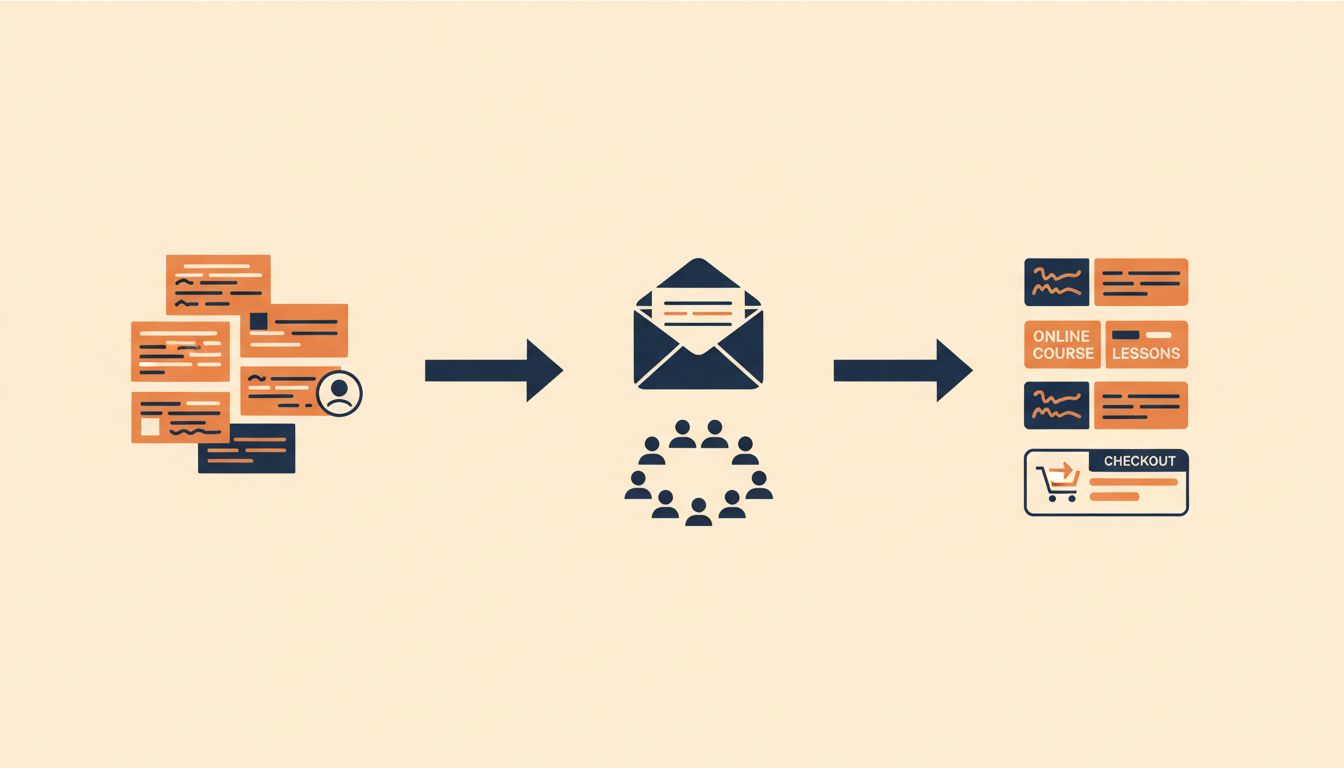
Fourth, he built a distribution loop rather than relying on one launch. Social content attracted attention; email created a direct relationship; courses monetised the audience; students and affiliates helped spread the offer; SEO gave useful content a longer life.
Finally, he systematised the business. The products teach the same publishing and audience-building processes that support his own distribution. That creates a coherent relationship between what he sells and how customers discover him.
Risks, Failed Assumptions and What Cannot Be Copied
- Platform dependence: LinkedIn and X can change algorithms, reach, rules or account access. Welsh himself said LinkedIn became more crowded in 2024 and responded by adding channels.
- Audience is not ownership: Followers can disappear or stop seeing posts. An email list is more portable, but it still depends on deliverability, consent and a provider.
- Course competition and AI: Generic social-media advice is easy to copy and increasingly easy to generate. A durable offer needs specific experience, credible examples, useful templates and measurable customer outcomes.
- Founder bottleneck: A business built around one person’s voice and expertise can become difficult to delegate. A virtual assistant helps with operations, but does not remove dependence on the founder’s reputation.
- Legal and compliance exposure: Email marketing needs appropriate consent and unsubscribe handling. Sponsorships and affiliate links should be clearly disclosed. Testimonials and earnings claims must not imply typical results without evidence. Course materials, images, music and templates also need clear rights.
- Survivorship bias: Many people post for years without building a paying audience. Welsh had prior executive experience, a network, strong writing ability and unusually good timing on LinkedIn. Those advantages are not automatically reproducible.
- Burnout risk: His business was designed around autonomy after a period of burnout, but consistent publishing, product launches and customer support can still become a treadmill. A one-person business is not automatically a low-stress business.
A Practical 7-Day Test for a Small Creator Business
Do not copy the follower count or build a 19-hour course first. Test one customer problem and one small paid outcome.
- Day 1: Choose one audience you understand and one expensive or frustrating problem they repeatedly mention. Write a one-sentence promise.
- Day 2: Speak with 10 potential customers. Ask what they currently do, what they have tried and what a successful result would be worth.
- Day 3: Publish one useful post that solves a small part of the problem. Include a clear invitation to receive a checklist or short guide by email.
- Day 4: Build a simple landing page and a three-email welcome sequence. Do not spend thousands on branding before the offer is validated.
- Day 5: Offer a small paid workshop, template pack or short course to the people who showed interest. Explain exactly what they will be able to do afterward.
- Day 6: Deliver the result manually to the first buyers. Record questions, objections and where people get stuck.
- Day 7: Review the evidence: qualified replies, email sign-ups, paid orders, completion and refund requests. Decide whether to improve, reposition or stop.
What to Measure in the First 30 Days
Set an experiment, not a fantasy forecast. For example, publish 12–20 useful posts for one audience, attract 100 qualified email subscribers, and attempt to sell five to ten paid beta places. These are suggested test targets, not industry benchmarks.
Track profile visits to email sign-ups, landing-page conversion, email clicks, conversations with qualified buyers, paid conversion, product completion, refunds and referrals. If people like the posts but do not join the list, the call to action or lead magnet may be weak. If they join but do not buy, the problem, offer or proof may be unclear. If they buy but do not finish, the product may be too long or poorly structured.
Five Transferable Lessons
- Build distribution before you need it. Welsh began publishing before leaving his job, so the audience was already there when he launched consulting.
- Let customer questions shape the product. Repeated inbound questions were stronger evidence than a guess about what people might buy.
- Make the offer easy to understand and easy to buy. A focused self-serve product can reduce sales overhead, but it still needs proof and a clear outcome.
- Own a direct channel. Social platforms can introduce you to customers; an email list gives you a more durable way to communicate with them.
- Keep the economics honest. Revenue, profit margin, cash collected, ARR, affiliate commissions and personal wealth are not interchangeable. Publish only the numbers you can substantiate.
Sources and What They Support
- Starter Story: How Justin Welsh Built a $2M Solopreneur Empire (April 12, 2023) — founder interview supporting the 2019 transition, 20,000 LinkedIn followers, $20,000 website spend, first-day consulting bookings, $50 course, course pricing, posting frequency, traffic metrics, affiliate commission, 2022 revenue and reported margin.
- Starter Story: The Growth Strategies Behind Justin Welsh’s $3.85M/Year Business (2024 update) — founder interview supporting the Creator MBA format, $1.51 million launch claim, $3.85 million annual revenue claim, 30,000 students, expanded channels and first virtual assistant.
- Indie Hackers: Surviving Solopreneurship — an Interview with Justin Welsh (September 12, 2022) — founder comments on his 90-day savings runway, revenue mix, monthly templates subscription, work schedule and preference for staying small.
- Justin Welsh’s official website — current public positioning, newsletter headline audience claim and the “$15M Solo Business” headline. The page does not define the $15M period or accounting basis.
- Justin Welsh: About — founder’s current description of his location, prior-company background, one-person-business positioning and newsletter/course offers.
- Justin Welsh official course store — current public list prices of $200 for each of the two listed courses and the store’s current student-count claim.
- The Saturday Solopreneur sponsorship page — current advertised $3,000 sponsorship price and seller-provided audience and campaign metrics.
Image credits and rights: All three visuals used for this article are original AI-generated editorial illustrations created for ToolsAI.club. They are conceptual illustrations, not photographs of Justin Welsh, not screenshots of his products and not documentary images. No third-party portrait or copyrighted course screenshot has been reproduced.